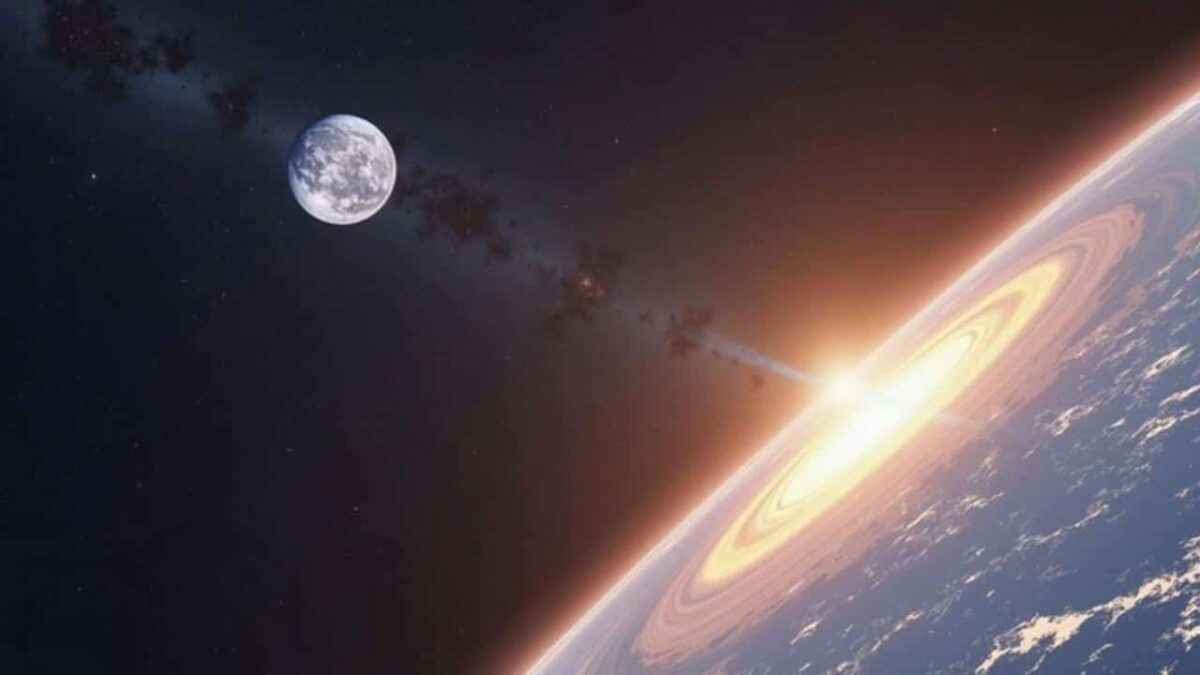
In the hushed confines of NASA’s Goddard Space Flight Center in Maryland, scientists gathered around flickering monitors, their eyes fixed on streams of data from the depths of space. Tension hung in the air as servers whirred softly, until a subtle anomaly broke through the cosmic static—a brief 10-second signal that had traveled an astonishing 13 billion years. This wasn’t some Hollywood-style extraterrestrial hail; it was a structured radio wave pattern, hinting at events from when the universe was just a toddler, barely a billion years old.
The discovery sent ripples of excitement through the team, replaying the data in loops and confirming its legitimacy. As astronomers pored over the readings, it became clear this NASA signal represented a breakthrough, bridging the vast expanse of time and space to our modern observatories.
Unraveling the Mystery of the 10-Second Cosmic Signal
The 10-second signal surfaced during standard reviews of deep-space radio data. Unlike random noise or typical pulsar emissions, it displayed remarkable organization—a sharp spike followed by a gradual fade, all within mere seconds. Its short duration, comparable to glancing at your phone, contrasted sharply with its epic voyage across expanding space-time.
Originating during the universe’s infancy, when the first galaxies began to form from swirling primordial gases, the signal endured cosmic expansion. This phenomenon, known as redshift, stretched the original ultra-fast event into the observed 10 seconds we detected today.
Key Features That Set It Apart
Experts at NASA’s Goddard and Jet Propulsion Laboratory (JPL) conducted exhaustive checks to validate the find. They cross-referenced data from international facilities like the Atacama Large Millimeter/submillimeter Array (ALMA) and the Very Large Array (VLA), eliminating possibilities of local interference or equipment faults.
- Signal profile: Rapid intensity peak, smooth exponential decay, and distinctive frequency drift.
- Cosmic journey impact: Extreme redshift elongated the burst, preserving its core signature.
- Leading theories: Linked to primordial black hole mergers or explosive births of early galaxies.
This rigorous process highlights how modern astronomy separates true cosmic phenomena from everyday artifacts, ensuring the 13 billion-year-old signal stands as a genuine relic.
Advanced Detection Methods Behind NASA’s Breakthrough
Capturing whispers from the universe’s dawn demands cutting-edge technology and unwavering dedication. Teams coordinate global “listening sessions,” syncing space-based instruments with earthbound radio telescopes to target distant sky patches over weeks or months. This synergy suppresses terrestrial noise, spotlighting feeble extraterrestrial emissions.
Post-capture, data undergoes sophisticated cleaning. Algorithms sift through solar bursts, ionospheric turbulence, and satellite pings, employing machine learning to elevate signals like this one. The result? Crystal-clear isolation of the NASA 10-second signal.
The Pivotal Role of the James Webb Space Telescope
The James Webb Space Telescope (JWST) was instrumental, scanning ancient galaxy clusters with its powerful infrared sensors. While ground arrays nabbed the radio burst—a variant of a fast radio burst (FRB)—JWST provided the visual backdrop, aligning the signal with cosmic dawn structures.
Originally a fleeting flash, the event ballooned to 10 seconds due to universal expansion. Spectral breakdowns correlate perfectly with reionization models, the era when the first stars blazed to life, ionizing neutral hydrogen and ushering in the age of light.
Exploring Possible Origins of the Ancient Burst
Scientists model various scenarios to explain the burst’s genesis. Candidates range from the implosion of massive early stars into magnetars, to colossal black hole smash-ups in nascent galaxy cores. High-fidelity simulations adjust variables like burst energy and propagation paths until they replicate the observed traits.
These recreations not only pinpoint the source but illuminate early universe physics. The 10-second signal may represent a radio echo from reionization, offering direct evidence of how the cosmos transitioned from darkness to stellar brilliance.
- Primordial star collapse: Hyper-massive stars shedding shells in violent outbursts.
- Magnetar flare: Ultra-magnetic neutron stars unleashing pent-up energy.
- Black hole activity: Mergers in dense proto-galactic environments.
Far-Reaching Implications for Science and Beyond
This detection refines our grasp of cosmic evolution. Accurate redshift data fine-tunes the Hubble constant, easing debates over expansion rates and dark energy dominance. It bolsters predictive models for galaxy assembly, dark matter distribution, and the Big Bang’s aftermath.
Technological ripples extend to everyday life. Precision timing from such analyses enhances GPS accuracy, fortifies satellite comms, and powers 5G networks through superior signal isolation techniques. Astronomy’s innovations often seed broader tech revolutions.
- Cosmology boost: Validates timelines from the universe’s first moments.
- Innovation spillover: Advances AI filtering for telecom and data centers.
- Future missions: Informs next-gen arrays like the Square Kilometre Array (SKA).
Moreover, it fuels human inspiration. Young minds drawn to STEM fields see real-world magic in data sifting, proving persistence uncovers universe-shaking secrets.
Addressing Skepticism and Common Misconceptions
Is it aliens? NASA stresses natural astrophysical origins—no modulated messages or repeating pulses point to intelligence. It’s a brute-force energy release, akin to cosmic fireworks from the dawn of time.
Yet, it sparks profound questions about life’s rarity amid hostile early conditions. Social media hype contrasts with methodical science, but this NASA signal underscores evidence over excitement.
The Enduring Legacy of This Cosmic Messenger
A fleeting 10 seconds spanning 13 billion years redefines our place in the cosmos. It exemplifies astronomy’s thrill: endless quiet pierced by profound revelations. With upcoming instruments like JWST’s successors and vast radio arrays, expect a cascade of similar ancient signals.
This burst lingers in global databases and scientists’ minds, inviting stargazers everywhere to ponder infinity. It weaves primordial fury into our daily tapestry, compelling us to tune into the stars’ timeless symphony. NASA’s triumph demystifies the heavens while sparking boundless curiosity, reminding us the universe’s tale continues for those who listen intently.
Is this signal proof of alien life?
How do scientists know it’s 13 billion years old?
Could the signal just be a technical glitch?
What kind of event could create such a burst?
Will we hear more signals like this?
